 KSR X33 uncrewed attack boat
 Atmaca anti-ship missiles
 Next Generation Corvettes
 AUSTRALIA
Australian Army’s NASAMS Reaches Full Operational Capability, Replacing RBS-70
Australia's version swaps in CEA Technologies radars and Hawkei-based launchers, with the 110th Battery of Adelaide's 16 Regiment the first unit equipped.
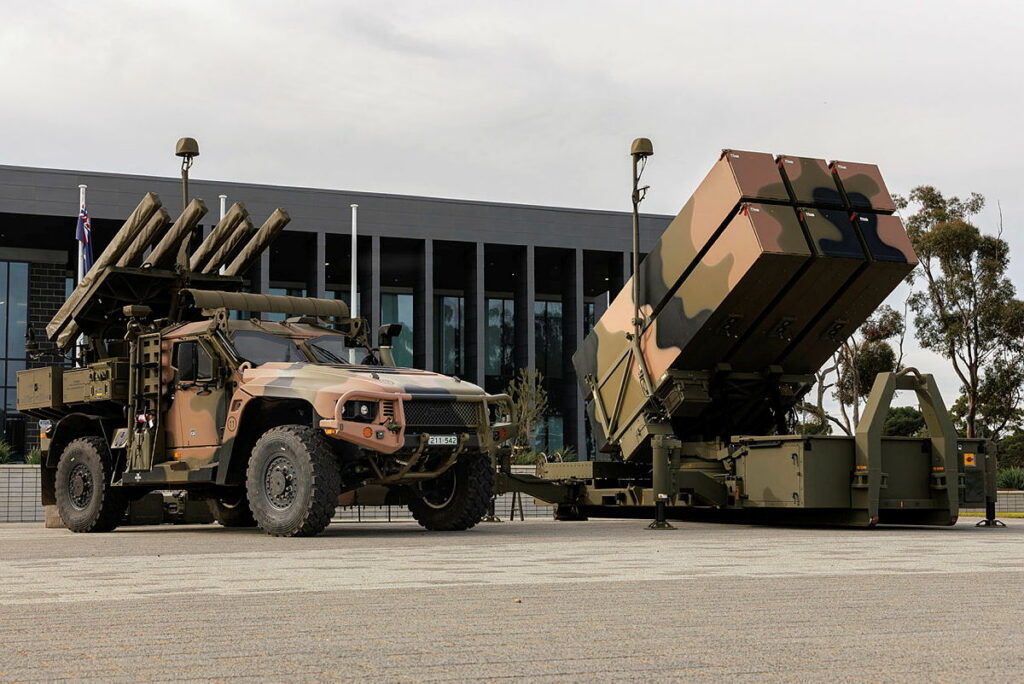
Australia’s short-range ground-based air defense program has reached its end goal. The Australian Army’s National Advanced Surface-to-Air Missile System, or NASAMS, has reached final operational capability, Australia’s defense ministers announced on September 9.
The declaration means the system has met its requirements and can be assigned to Australian Defence Force operations. NASAMS now becomes the army’s main air defense weapon, taking over from its older short-range systems, including the RBS-70.
From Approval to Service
Canberra approved the Short Range Ground Based Air Defence project, known as SRGBAD, in 2017. Two years later it widened the scope by adding Active Electronically Scanned Array radars from CEA Technologies, a Canberra-based company. Australian firms also handled integration of key components and are providing sustainment and support inside the country.
Within the wider Joint Integrated Air and Missile Defence capability, NASAMS forms the innermost layer.
Defence Minister Richard Marles, who is also deputy prime minister, called the milestone significant for the country’s integrated air and missile defense. “NASAMS provides the army with a modern, highly capable air defence system that enhances our ability to protect Australian Defence Force personnel, critical assets and infrastructure from a range of airborne threats,” he said.
Defence Industry Minister Pat Conroy said the system protects Australian forces “from modern airborne threats, including cruise missiles, aircraft, and drones,” and pointed to the local radar as evidence of what Australian industry adds. “Australian-designed radar technology is a key part of this capability,” he said.
An Australian Configuration
The army’s version differs from the baseline. It combines the CEA radar with an infrared and optical sensor and a launcher mounted on the Hawkei vehicle.
NASAMS can fire AMRAAM or Sidewinder missiles, either from the high-mobility Hawkei launchers or from Mk II canister launchers carried on HX77 heavy trucks. Each launcher holds up to six missiles. A NASAMS troop operates three launchers.
The first unit to receive the system is the 110th Battery of 16 Regiment, based in Adelaide. The regiment plans to field two NASAMS batteries.
The Sellers
NASAMS was developed by Norway’s Kongsberg Defence & Aerospace and US company Raytheon together with the Royal Norwegian Air Force. Its interceptors carry high-explosive blast-fragmentation warheads and can engage fixed-wing and rotary aircraft, drones and cruise missiles out to about 60 kilometers (37 miles). The networked sensors detect threats at about 120 kilometers (75 miles) and engage targets as high as 21,000 meters (69,000 feet).
More than a dozen countries use or are buying NASAMS, among them Ukraine, Chile, Spain and the United States.

 SOUTHEAST ASIA · 18 NOV
 LOCAL INDUSTRY · 16 NOV