 KSR X33 uncrewed attack boat
 Atmaca anti-ship missiles
 Next Generation Corvettes
 AUSTRALIA
Australia’s First Hunter-Class Frigate Reaches Keel Laying at Osborne
The lead ship of the six-frigate program pairs a British Type 26 hull with an Aegis combat system and Australian-designed CEAFAR2 radar.
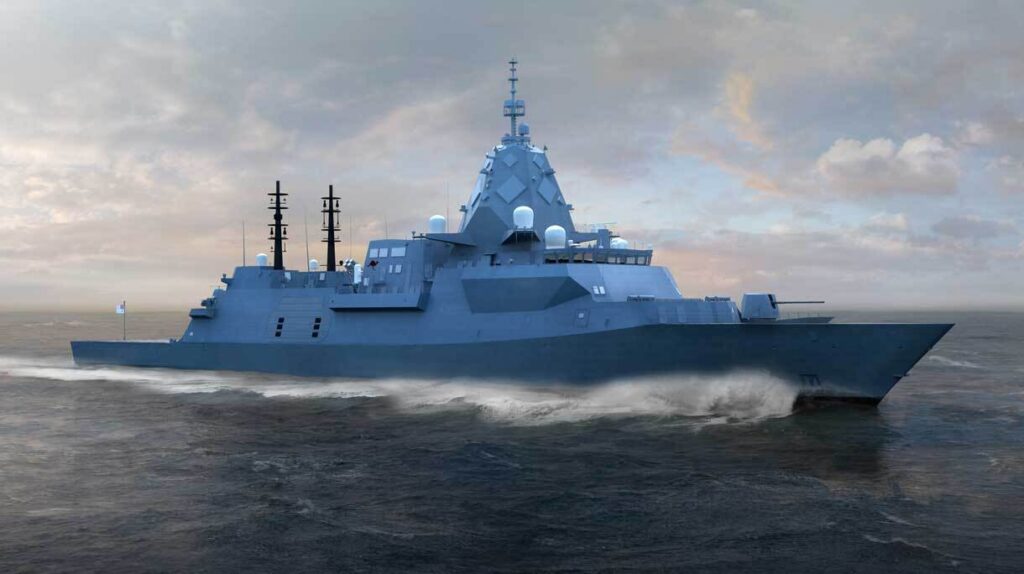
Australia’s anti-submarine frigate program has passed its first major assembly milestone. BAE Systems Maritime Australia has laid the keel of NUSHIP Hunter, the lead ship of the Royal Australian Navy’s Hunter class, at the Osborne Naval Shipyard in South Australia.
The ceremony came more than two years after construction formally started in June 2024. Hunter is the first of six frigates Canberra has ordered from the yard, the company once known as ASC Shipbuilding. All six are being built in Australia, and the class is scheduled to enter service in the early 2030s.
David Shepherd, managing director of BAE Systems Australia’s surface ships business, said the frigates would “form the backbone of the Royal Australian Navy’s fleet for decades to come,” pointing to the ships’ weapons, sensors and modular mission bay as the reason they can take on missions beyond hunting submarines.
A British Design, Australianized
The Hunter class starts from BAE Systems’ Type 26 Global Combat Ship. Australia has reworked it to its own requirements. The biggest changes are the combat system and the main sensor. The ships will run the US Aegis combat management system with an Australian interface and carry the CEAFAR2 phased array radar, which is designed and built in Australia. They are also being fitted to operate the MH-60R Seahawk helicopter.
According to the Royal Australian Navy, the frigates are meant for anti-submarine warfare first, with air defense, surveillance, intelligence gathering and disaster relief among their other tasks.
Each ship is 151.4 meters (497 feet) long with a 20.8-meter (68-foot) beam. A combined diesel-electric or gas propulsion plant gives a top speed above 27 knots and a range of 7,000 nautical miles.
The first three hulls will be named HMAS Hunter, HMAS Flinders and HMAS Tasman, after Australian regions. Names for the last three have not been announced.
The Supplier Base
The program has pulled a long list of contractors into the build. Hull steel comes from Melbourne-based BlueScope Steel under a five-year agreement signed with BAE Systems in November 2025.
Contracts placed last year went to L3Harris for the integrated platform management system, Babcock for lift and hoist equipment, and STS Defence for configurable communications masts. Bohemia Interactive Simulations is supplying its Virtual Battlespace training software, and Ultra Maritime is providing torpedo defense technology.
With the keel down on the lead ship, attention turns to the build rate for the five hulls that follow at Osborne.

 SOUTHEAST ASIA · 18 NOV
 LOCAL INDUSTRY · 16 NOV